The era of spending six months and $50,000 on an agency just to see if customers want your product is officially dead. In 2026, the rise of “vibe coding” and agentic code engines has turned software development into an editorial conversation. You describe an architecture, adjust an interface through dialogue, and watch a working product materialize in minutes.
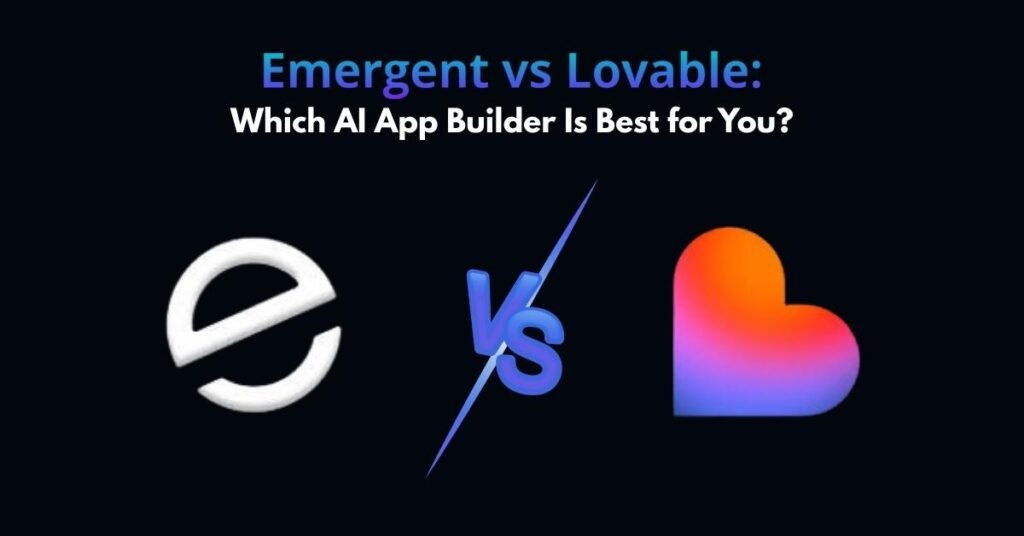
Two platforms currently dominate founder discussions: Emergent and Lovable.
Both platforms promise to take you from a napkin sketch to a production-ready application using plain English. However, they operate on fundamentally different philosophies, architectures, and target outputs.
If you are hunting for the best ai app builder 2026 has to offer, picking the wrong platform can leave you stranded with high credit bills, architectural dead ends, or an app that cannot deploy where your users actually hang out.
Here is an honest, data-backed emergent ai comparison and deep dive into how both builders help you launch, scale, and monetize your startup.
The Core Philosophy: Aesthetic Velocity vs. Autonomous Full-Stack Engineering
To choose between these tools, you have to understand the specific problem each was built to solve.
Lovable: The Design-Obsessed Co-Founder
Lovable treats software creation as a visual dialogue. It is engineered primarily for web applications, SaaS dashboards, internal tooling, and client portals. Built on top of modern web standards (React, Tailwind CSS, Vite, and Supabase integration), Lovable shines because its default styling looks like it was designed by a world-class product agency.
When you ask Lovable to create a project management dashboard, it does not hand you unstyled wireframes. It produces micro-interactions, responsive typography, subtle shadows, and clean UI components out of the box. For non-technical founders, marketers, and solo operators who need an immaculate web demo in front of investors by 4 PM, Lovable is a masterclass in frontend polish.
Emergent: The Autonomous Agent Swarm
Emergent approaches app development from an engineering and infrastructure angle. Rather than acting simply as an autocomplete chat assistant, Emergent orchestrates specialized agents. One agent scopes your prompt, an architect agent structures database schemas and APIs, a coding agent writes the solution, and a testing agent actively executes test suites to catch regressions before you ever view the preview.
Crucially, Emergent outputs full-stack web applications alongside React Native / Expo mobile code. If your startup idea requires an iOS or Android client, Emergent generates the actual mobile project structure you can run directly on your smartphone via Expo.

Feature-by-Feature Breakdown: Emergent vs. Lovable
| Feature Dimension | Emergent | Lovable |
| Primary Output | Web Apps + Mobile Apps (React Native / Expo) | Web Apps, Responsive SaaS, Dashboards |
| Native Mobile App Builds | Generates Expo/React Native code; self-submit to App Store | Web only (No native mobile source output) |
| Architecture Engine | Multi-agent swarm (scaffolding, testing, coding) | Chat-driven direct codebase modification |
| Backend Integration | Auto-generated backend APIs + DBs + Auth | Built-in Supabase (Lovable Cloud) integration |
| Code Ownership & Export | Full ownership, direct bidirectional GitHub sync | Full ownership, direct bidirectional GitHub sync |
| Enterprise Readiness | SOC 2 Type I posture, custom security contexts | Enterprise workspace controls, custom domain management |
| Design Quality Out-of-the-Box | Practical, functional, developer-styled | Exceptional, agency-grade UI/UX components |
How Each Tool Actually Helps the User: The Real Value Proposition
A software builder is only as valuable as the manual friction it eliminates. Here is exactly how each tool impacts your startup workflow:
1. Speed to Market: The Validation Phase
- How Lovable Helps You: If you are building a B2B SaaS, an internal CRM, or a customer-facing marketplace, you cannot afford a prototype that looks amateurish. Lovable reduces the time to build a fully styled web front end from 3 weeks to 30 minutes. Because it connects cleanly with Supabase for user auth, PostgreSQL tables, and file storage, you have an operational product to test with early customers immediately.
- How Emergent Helps You: If your business hypothesis requires a mobile interface (e.g., local delivery tracking, fitness logging, field operations), Lovable cannot deliver native mobile code. Emergent acts as a no code app generator for startups that produces legitimate mobile repos. You scan an Expo QR code with your phone, and your prompt runs on your device within minutes.
2. The Iteration Loop and Bug Fixing
- How Lovable Helps You: Lovable features a visual inspector. You can click on an individual UI element (like an awkward button, broken modal, or navigation bar) and issue a hyper-targeted prompt: “Make this dropdown multi-select and update the accent color to slate.” It edits the code with surgically precise diffs.
- How Emergent Helps You: One of the most common complaints with AI builders is regression—where fixing an auth error accidentally breaks your billing form. Emergent’s automated testing agent evaluates dependencies behind the scenes. It verifies whether new additions broke existing modules before rendering the build, significantly reducing silent bugs.
3. Scaling Beyond the Platform: Avoiding Vendor Lock-In
Both tools respect modern software autonomy:
- You are not trapped in a proprietary closed sandbox like legacy builders (e.g., Bubble, Webflow).
- Both platforms provide two-way GitHub synchronization. When your application reaches the stage where you hire senior software engineers, they can clone the repository, run standard
npm install, and deploy it to AWS, Vercel, or custom servers without rewriting from scratch.

Pricing, Credits, and Hidden Costs: The 2026 Reality
AI app builders live and die by their credit models. Before launching, understand how usage converts to cash:
- Lovable Pricing Dynamics: Lovable starts at a generous free tier with daily build grants. Its Pro plan ($25/month) includes 100 monthly credits plus ongoing daily build grants. Lovable’s biggest advantage is credit rollover: unused monthly subscription credits roll over for up to two months, protecting your budget during quiet development weeks. Deploying your app to a live URL consumes zero extra platform fees on your standard setup.
- Emergent Pricing Dynamics: Emergent starts slightly cheaper on paper with a $20/month Standard tier (100 credits) and scales to a heavy-duty $200/month Pro tier featuring a 1-million-token context window for larger codebases. However, the hidden cost lies in deployment: pushing an app to production typically consumes 50+ credits plus an ongoing hosting fee, and unused monthly credits do not roll over.
Verdict: Which AI App Builder Fits Your Startup Idea?
Choose Lovable If…
- Your project is a web-first SaaS, directory, or client portal: Lovable builds modern, fast React web applications better than virtually any competitor.
- You want agency-level UI/UX on day one: You do not want to spend hours prompting the AI to fix ugly borders, misaligned flexboxes, or clashing colors.
- You want forgiving credit dynamics: You value daily build allowances, credit rollover, and free standard web deployments.
Choose Emergent If…
- You need a mobile application: If your users demand an iPhone or Android app on their home screens, Emergent’s React Native and Expo pipeline is mandatory.
- You prefer autonomous execution over micro-editing: You would rather write a comprehensive multi-paragraph specification, let an agent swarm run test suites, and review an end-to-end full-stack result.
- You are building complex custom backend logic: You want the platform to handle API routes, authentication, and database schemas holistically within an agentic loop.
If you are evaluating a lovable ai alternative specifically for mobile apps or complex agentic testing, Emergent is the premier candidate. If your focus is pure web velocity with design perfection, Lovable retains the crown.